HONEY CARE · OCTOBER 5, 2026
How to soften
crystallized honey
gently.
Cloudy, grainy or firm honey is usually showing a natural texture change—not a reason to discard the jar.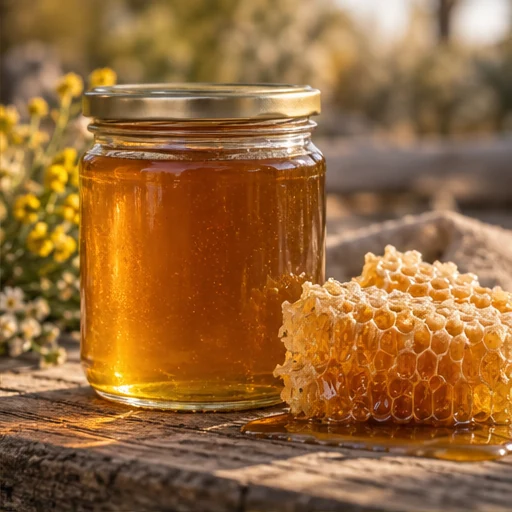
Even in warm Las Vegas, honey can crystallize in a pantry. Floral source, natural sugar balance, small pollen or wax particles, and storage temperature all influence how quickly a jar changes. The transformation is ordinary—and often reversible.
01 · THE SCIENCE
Why honey forms crystals.
Honey is a concentrated sugar solution. Over time, some glucose can separate from the liquid and organize into crystals. Some floral sources crystallize quickly, while others remain fluid much longer. That difference does not prove that one jar is purer or better than another.
Utah State University Extension notes that crystallized honey can still be safe to use and may be returned to liquid form with hot water around the container. Penn State Extension likewise describes crystallization as a natural process and recommends gentle warming rather than overheating.
02 · THE METHOD
Use a patient warm-water bath.
Make sure the jar is closed securely. Set it upright in a bowl or saucepan of warm water, keeping the water level below the lid. Let the jar sit, then stir the honey with a clean, completely dry spoon if the opening is wide enough. Replace the cooling water with fresh warm water and repeat until the texture is where you want it.
Work slowly, especially with a large jar. Fine crystals may dissolve sooner than a firm center. There is no need to force every crystal out if the honey is already easy to spoon.
03 · PROTECT THE FLAVOR
Avoid boiling water and direct heat.
Very hot water, a stovetop flame and uncontrolled microwave heating can create hot spots and change honey's color and delicate aroma. Gentle, indirect warmth gives you more control. Never place a plastic container against a hot pan surface; transfer only if the container is food-safe and completely dry.
Keep the lid area dry. Water introduced into the honey changes the product's moisture balance, so wipe the outside of the jar before opening it.
04 · ANOTHER OPTION
You may prefer it crystallized.
Crystallized honey is pleasantly spreadable and less likely to drip. Try it on toast, biscuits, warm oatmeal or a cheese board. Fine crystals can feel almost creamy, while larger crystals give a more rustic texture.
If you enjoy comparing textures, explore our four regional honey sources or read about why honey color varies. Natural differences are part of tasting honey as an agricultural food.
05 · COMMON QUESTIONS
Will it crystallize again?
It may. Warming dissolves existing crystals, but it does not permanently change the natural balance of the honey. Store the closed jar in a stable, dry cupboard—not the refrigerator—and rewarm only the amount you need.
See our complete honey care guide, sourcing standards and science and stewardship approach. For current jars or Rhodes Ranch-area pickup, contact our family.
REFERENCES
Further reading.
Read practical storage guidance from Utah State University Extension and Penn State Extension.
“Pleasant words are as an honeycomb, sweet to the soul, and health to the bones.”Proverbs 16:24 · KJV